
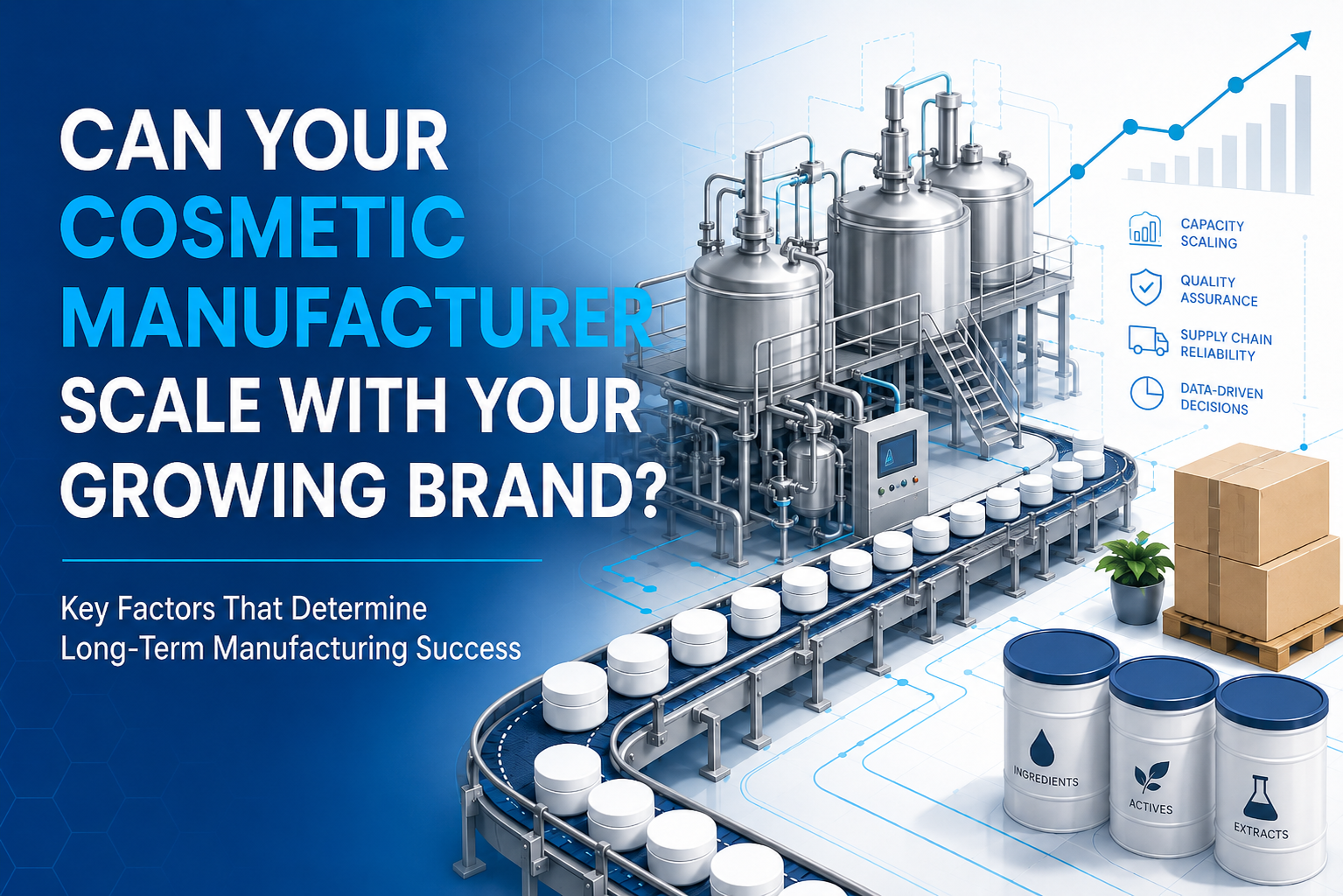
Yes, a cosmetic manufacturer can scale with your growing brand. But bigger tanks, more filling equipment, and a larger facility are only part of the answer.
A manufacturer also needs the systems, supplier relationships, production visibility, quality controls, and communication habits required to manage more moving pieces at once. That is what helps a beauty brand protect inventory, retail commitments, cash flow, and its customer experience as volume grows.
Short Answer: What Does a Scalable Cosmetic Manufacturer Need?
A scalable cosmetic manufacturer can do more than accept a larger purchase order. It can forecast raw materials, coordinate packaging, reserve production time, manage quality checks, communicate risks early, and adapt its process as the brand enters retail or launches more products.
Ordering 50,000 or 250,000 units is not the same as ordering 5,000 units with an extra zero on the purchase order. Larger orders require different planning, purchasing, scheduling, payment structures, and risk management.
At AMR Labs, we have supported brands moving from early production runs into national and international retail distribution. The strongest relationships are not simply buyer-and-vendor arrangements. They work like one supply-chain team.
What Changes When Order Volume Grows?
Growth changes more than the number of units being produced. A formula that is manageable in a 5,000-unit run may require multiple compounding batches, more material commitments, additional production shifts, more packaging, and a different filling plan at 50,000 or 250,000 units.
At the same time, the brand may be launching products, entering a major retailer, running promotions, expanding internationally, and managing replenishment orders. One missing ingredient, a late packaging shipment, or a sudden increase in sales can turn what looked like a comfortable production schedule into an urgent problem.
The compounding plan, filling schedule, material purchases, quality review, and freight handoff must stay coordinated. A delay in one area can create a second problem in another.
That is why scalability should be measured by how well a manufacturer manages complexity, not simply by how many units it says it can produce. A clear cosmetic manufacturing process is the foundation, but the process needs to hold up when sales, inventory, materials, and deadlines all change at once.
Green Flags and Red Flags When Evaluating a Manufacturer
The following visual reference makes it easier to evaluate a prospective or current partner. Look for a manufacturer that provides specific examples, asks about sales and inventory, identifies high-risk materials, reviews packaging details, and communicates realistic options early.
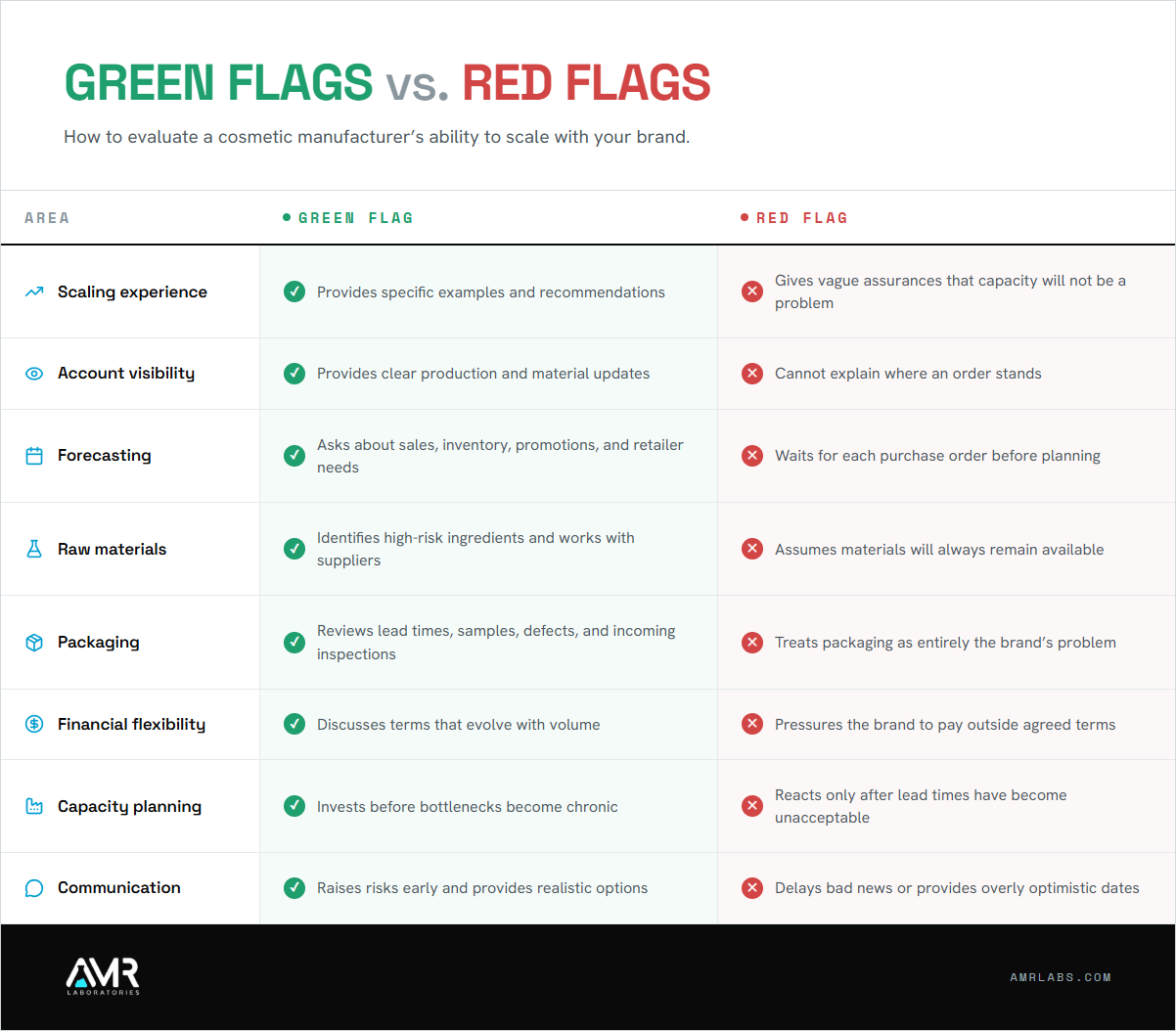
| Area | Green flag | Red flag |
|---|---|---|
| Scaling experience | Green flag Provides specific examples and recommendations. |
Red flag Gives vague assurances that capacity will not be a problem. |
| Account visibility | Green flag Provides clear production and material updates. |
Red flag Cannot explain where an order stands. |
| Forecasting | Green flag Asks about sales, inventory, promotions, and retailer needs. |
Red flag Waits for each purchase order before planning. |
| Raw materials | Green flag Identifies high-risk ingredients and works with suppliers. |
Red flag Assumes materials will always remain available. |
| Packaging | Green flag Reviews lead times, samples, defects, and incoming inspections. |
Red flag Treats packaging as entirely the brand's problem. |
| Financial flexibility | Green flag Discusses terms that evolve with volume. |
Red flag Pressures the brand to pay outside agreed terms. |
| Capacity planning | Green flag Invests before bottlenecks become chronic. |
Red flag Reacts only after lead times have become unacceptable. |
| Communication | Green flag Raises risks early and provides realistic options. |
Red flag Delays bad news or provides overly optimistic dates. |
Be cautious when a manufacturer gives vague assurances about capacity, cannot explain where an order stands, waits for every purchase order before planning, or delays bad news until there are few options left.
One of the best questions to ask is open-ended: What do you normally do when one of your clients begins scaling quickly?
Then let the manufacturer answer. An experienced team should naturally discuss forecasting, raw-material commitments, packaging inventory, production reservations, quality control, routine planning calls, and payment structures. It is a good sign when the team introduces risks or solutions you had not considered.
For broader guidance on selecting a partner, read How to Find a Reliable Cosmetic Manufacturer. This article is specifically about what happens when that manufacturer must support a much larger program.
Case Study: From Three Haircare Products to Sephora Worldwide
A few years ago, AMR Labs began working with an emerging haircare brand with approximately four employees and a line of two or three products. Within one year, the company raised a Series A round, expanded to about 10 products, grew to more than 30 employees, and secured Sephora worldwide placement.
AMR Labs manufactured the brand's entire line. We needed to increase production of the existing products while helping move several new products through custom formulation, development, scale-up, and commercialization.
A normal purchase-order relationship was no longer enough. We began holding a weekly supply-chain call with the client to review active productions against finished-goods inventory, recent and projected sales, Sephora inventory requirements, raw-material availability, packaging availability, new-product development, upcoming launches, and production scheduling.
Those conversations made it possible to identify the products most at risk of going out of stock and prioritize them before a problem became a retail issue. Rather than treating every open production as separate, we could see how a material decision, a launch date, or a retailer replenishment request affected the rest of the program.
We also reviewed formulas for long-lead or higher-risk ingredients. With suppliers, we discussed future requirements, material reservations, inventory held for AMR Labs, larger advance productions, and supply for multiple runs.
The goal was to avoid learning, only after the next purchase order arrived, that a critical material was unavailable. For a growing program, the manufacturer should be able to explain why a material is risky and what practical choice the brand has: reserve it, buy it earlier, qualify an alternative, or carry more finished inventory.
There were times when client packaging arrived on a Monday morning, our quality team completed an incoming AQL inspection, and filling started that afternoon. That kind of response requires coordination between the client, packaging supplier, receiving team, quality control, production scheduling, compounding, and filling lines. It is the result of established systems and communication, not luck.
Raw Materials and Packaging Can Stop Production
A production line can be available while a specialty ingredient is not. Bulk can be ready while packaging is delayed in customs. The formula, labor, equipment, and schedule may all be in place, but without approved components there is nothing to fill.
In our experience, raw-material availability is often the largest scaling risk. A supplier that normally has 100 kilograms of an ingredient in stock may not have 1,000 kilograms ready when a brand's sales increase tenfold. The larger amount may need to be made specifically for the order and can depend on another ingredient, a harvest, an overseas facility, or international freight.
Some made-to-order materials can take 14 weeks or more. Certain specialty pigments manufactured in Japan can take longer. There is no universal reorder rule because each formula has its own risks. A manufacturer should explain which materials have long lead times, are single-source, are made to order, or may justify purchasing inventory in advance.
Packaging deserves the same attention. Delayed components, customs holds, incorrect decoration, damaged bottles, labels that do not fit, and pumps that fail can all stop production. Brands should begin packaging planning early and should not treat a supplier's estimated ship date as the same thing as an approved delivery date at the manufacturer.
For the first few runs, production samples from the packaging supplier can help identify obvious defects before the full shipment leaves the facility. They do not replace a full incoming inspection, but they can prevent a painful surprise. At scale, packaging is not merely a creative choice. It is a production input that needs the same planning discipline as the formula and raw materials.
Case Study: A Two-Day Lead Time Became More Than Two Months
One AMR Labs client was preparing a co-branded product that would sell alongside its existing Target assortment. A key raw material made in Germany had historically shipped from a U.S. distribution center within about 48 hours.
For this order, an international manufacturing and shipping disruption turned that normal lead time into a delay of more than two months. Adding labor to a filling line could not solve the problem; the ingredient simply did not exist in the quantity needed to make the order.
Throughout the delay, we stayed in regular contact with the supplier and client so the brand could adjust its retail and inventory plans with the most accurate information available. We did not promise a date before the supplier could support it; the priority was keeping the client informed while preserving a workable recovery plan.
When the material arrived, we moved the production into manufacturing and filling immediately. We first completed enough units for the client's initial Target supply, then finished the remainder shortly afterward for replenishment.
Not every disruption can be prevented. The real test is whether the manufacturer identifies the risk, communicates honestly, and responds quickly once the missing material becomes available.
Inventory Mitigates Risk
Vic, AMR Labs' packaging engineer, often says, Inventory mitigates risk. That applies to raw materials, packaging, and finished products.
Extra approved packaging can create options. It may allow a manufacturer to complete an urgent partial production, use materials already in stock, split work across filling lines, or ship an initial retailer quantity before the full order is complete. Without packaging, even a ready formula and a ready line are effectively stuck.
For brands that need post-production support, beauty product fulfillment can keep finished inventory close to production and ready for retail, DTC, or marketplace shipments.
This does not mean a brand should buy unlimited inventory. Excess inventory ties up cash, consumes warehouse space, and can become aged or obsolete. The right buffer depends on sales velocity, sales variability, retailer commitments, material and packaging lead times, formula complexity, filling speed, finished-product shelf life, and the cost of being out of stock.
A fast-filling product made with common materials needs a different buffer than a difficult-to-compound product using imported pigments and custom packaging. The buffer should reflect the actual risks of that individual product, not a blanket rule for the whole brand.
The same principle applies to ordering. A brand that waits until the last possible moment may preserve cash temporarily, but it leaves almost no room for a material delay, a failed component inspection, an unexpected retail order, or a stronger-than-expected promotion.
Payment terms and ordering procedures should evolve as a brand grows. The manufacturer and brand may decide to use an initial deposit to reserve the highest-risk materials, begin additional payments earlier, divide the remaining balance into smaller installments, or align final payments with production milestones. The point is to reduce supply-chain risk without creating unnecessary cash-flow pressure for either party.
Unexpected pressure to pay outside agreed terms is different. Changes should be planned, transparent, and built to support the relationship.
Capacity, Visibility, and Communication Must Grow Too
A manufacturer must evaluate its own constraints before they become chronic bottlenecks. At AMR Labs, we continually review what is limiting production. When compounding capacity became the constraint, we added tanks. When filling became the constraint, we added production lines. When offline coding became a pain point, we added coding machines.
That ongoing review helps protect the lead times of both large and small clients. Without it, a facility can find itself reacting after delays have already become normal, or allowing the biggest accounts to absorb capacity that growing brands need.
We also use production sensors on manufacturing lines and an advanced scheduling system to give our team live visibility into what is running, which line is producing it, whether it is ahead or behind, and where a delay could affect another order.
Technology is not a substitute for good service. A spreadsheet is not automatically a problem, and advanced systems do not guarantee good communication. What matters is whether the manufacturer can understand its capacity, provide accurate updates, raise risks early, and explain the available options.
Brands should ask how production is scheduled and tracked, who owns the daily updates, and how a potential delay is escalated before it becomes a missed commitment. Not every update will be good news. Transparent bad news is still better than an optimistic date that changes after a brand has made commitments to retailers or customers.
Eight Questions to Ask Before You Grow
- What do you normally do when a client begins scaling quickly?
- How do you determine your actual available production capacity?
- How will we receive updates on active productions, materials, and schedule changes?
- How do you identify ingredients with long or unpredictable lead times?
- Can you reserve or purchase raw materials for future productions?
- How do you inspect incoming packaging, and what happens when components fail?
- Can you support partial productions or split shipments when a retailer needs an urgent quantity?
- Can payment terms and ordering procedures change as our volume grows?
Pay attention to the depth of the answers. The best answer is not always a promise that everything will be easy. An experienced manufacturer may identify risks, tradeoffs, or planning requirements you had not considered. That honesty is a green flag.
Frequently Asked Questions
How can a beauty brand tell whether its manufacturer can handle much larger orders?
Ask an open-ended question about what the manufacturer normally does for scaling clients. An experienced team should introduce ideas based on situations it has handled before, such as material forecasting, packaging inventory, production reservations, planning calls, or modified payment terms. A team that only agrees with your suggestions may have limited scaling experience.
When should a growing beauty brand place its next production order?
There is no universal reorder point. Timing depends on the formula, material lead times, packaging, filling speed, sales velocity, and the cost of being out of stock. In some cases, purchasing a few difficult materials in advance is enough. In others, the brand needs more finished inventory because the product is slow to compound or fill.
What are the most common causes of cosmetic manufacturing delays?
Raw-material availability is a common cause, especially for specialty ingredients from a single supplier. Packaging manufacturing problems, freight delays, customs delays, and defective components can also affect timing. Brands can reduce risk by ordering earlier, reviewing samples during initial packaging runs, and keeping approved packaging available.
How far in advance should a brand forecast raw-material needs?
It depends on the formula. Some made-to-order materials can require about 14 weeks, while certain specialty pigments can take longer. Ask the manufacturer to identify the highest-risk materials in each formula and explain the recommended forecast.
Can payment terms change as a beauty brand grows?
Yes. The brand and manufacturer can discuss using an initial deposit to secure difficult materials, reducing the upfront amount where appropriate, or dividing the balance into smaller payments that begin earlier. The goal is to order early enough to reduce supply-chain risk without unnecessarily restricting the brand's cash flow.
The Bottom Line
A cosmetic manufacturer can scale with your brand when it has more than available equipment. It needs experienced supply-chain planning, strong supplier relationships, packaging coordination, quality systems, reliable production visibility, flexible procedures, and honest communication.
AMR Labs brings custom formulation, production planning, contract filling, packaging, and quality control together to support brands from an initial launch through larger retail programs. If your brand is preparing for larger productions, retail expansion, or a growing product line, complete the New Product Profile and tell us where your brand is today, where it is headed, and what support you need from your manufacturing partner.